Hall, Stairs and Landing Colour Schemes in Swindon
Stairwells have the most awkward light in any house: a bright landing window at the top and near darkness at the bottom, on the same continuous wall.
Swindon's mix of Victorian railway terraces in Old Town, 1930s semis around Park North, and thousands of new-build estates in Wichelstowe and Tadpole Garden Village means every colour scheme decision depends on which era of house you're standing in.
Our honest view after doing this a lot
Changing colour halfway up the stairs because the ladder would not reach is the single most common thing we get asked to put right.
- •One continuous wall colour from front door to top landing. Changing colour per floor makes the house feel smaller, not bigger.
- •Painting the doors a single deeper colour and leaving the frames the same as the walls. It quietens a hallway with six doors in it.
- •A washable matt rather than a flat matt. Bags, prams, shoes and dogs all hit hallway walls.
- •Warm off-whites in halls with a single glazed door. Cool greys go dead in borrowed light.
- •Dark feature walls halfway up a stairwell. They almost always get repainted within two years.
- •Gloss on a handrail. It shows every fingerprint and stays tacky far longer than eggshell.
- •Choosing the colour from a chart held at the front door, where the light is nothing like the landing.
- •Two-tone dado rails in magnolia over beige.
- •Grey walls with brilliant white trim and chrome switches, the 2016 look.
- •Feature wallpaper on the chimney breast of a landing.
Working with Swindon homes on hall, stairs and landing colour ideas
Swindon sits within SN13, SN14, SN15, and Wiltshire's mix of chalk downland and clay vale means properties experience driving rain from the south-west and frost pockets in the valleys. That climate is the main reason we always specify the right primer system here — particularly on jobs that involve stone-cottage interior lime plaster patching.
Properties around the centre of Swindon typically feature traditional UK construction methods typical of Swindon. Our interior painting approach for these homes accounts for those specifics so the finish bonds properly and lasts.
Where we work near you. It sits between Royal Wootton Bassett (about 6 miles W), Highworth (about 6 miles NE), Marlborough (about 12 miles S) and Cirencester (about 17 miles N). If your property sits between two of those, the price does not change.
Within SN13 alone we've handled everything from stone-cottage interior lime plaster patching through to modern estate magnolia-out repaints in Calne and Royal Wootton Bassett, and the postcode boundary running through Swindon means properties on the SN14 side often present slightly different issues again. Most interior painting jobs in the area touch on at least one of these patterns, which is why we always survey thoroughly before quoting — generic per-room pricing rarely matches what a Swindon property actually needs.
Local material reality matters: traditional UK construction methods typical of Swindon dominates parts of Swindon that newer build does not, and the local climate adds its own demands. Wiltshire's mix of chalk downland and clay vale means properties experience driving rain from the south-west and frost pockets in the valleys. Combined, this means our interior painting specifications for properties around the centre of Swindon will often differ noticeably from those a few postcodes away — and rightly so, given how differently those properties behave over a ten-year horizon.
Wiltshire's mix of chalk downland and clay vale means properties experience driving rain from the south-west and frost pockets in the valleys. For Swindon interior painting customers that has practical consequences: the timing window for exterior work is tighter than people often assume, and interior rooms on north-facing elevations within the SN13 and SN15 areas are noticeably more prone to condensation. We factor both into the products and additives we recommend during the quote stage.
Specification: what goes on, in what order
Treat the whole hall, stairs and landing as one room, not three. One wall colour throughout, one trim colour throughout, and let the doors do the work. Walls take a washable matt (Little Greene Intelligent or Dulux Diamond), trim takes water-based eggshell, and the handrail takes two thin coats rather than one thick one.
Finish. Durable washable matt on the walls, eggshell on the spindles and handrail, and a hard-wearing satin or stain on treads if they are exposed.
Ceilings get a genuinely flat matt with no sheen at all, because ceiling light is raking light and anything reflective picks out every joint.
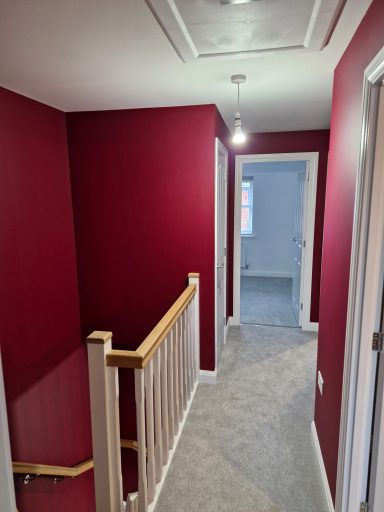
Paint the stairwell wall colour up onto the ceiling line of the highest landing rather than cutting in halfway up. A cut line halfway up a stairwell is visible from below and makes the space feel chopped.
Shaded White walls, Railings handrail, Inchyra Blue doors. It reads calm from the front door and still has something to look at on the landing.
Still deciding? That is the right place to be
There is no rush and nothing to book. If you want a second opinion on a shortlist, we will give you one without turning it into a sales call.
How this plays out in local housing stock
If you live here and have to look at it every day
Owner-occupiers can afford to be braver with colour than landlords, because you are the only person who has to love it. The trade-off is that you also live with the mistakes, so sample properly before committing a whole room.
If the house is new and the paint is already letting it down
Developer contract emulsion is a primer pretending to be a finish. Any colour you choose will look thin over it, so the first coat is about building a proper base, not about the colour at all.
How the light in this room changes the answer
Before any colour name comes up, one thing decides most of it. Stairwells have the most awkward light in any house: a bright landing window at the top and near darkness at the bottom, on the same continuous wall.
Treat the whole hall, stairs and landing as one volume rather than three rooms. Break the colour at a consistent architectural line, such as the dado or the stair string, not wherever the wall happens to turn. Get that right and the specific colour name matters far less than people expect.
Owner-occupiers can afford to be braver with colour than landlords, because you are the only person who has to love it. The trade-off is that you also live with the mistakes, so sample properly before committing a whole room.
Old Town's tall Victorian ceilings drink deep colours beautifully; the 1930s semis in Park North have modest ceiling heights that need warmer, lighter tones; Wichelstowe new builds need proper prep before any decorative paint holds up.
Swindon sits on higher ground with strong east-west light — north-facing rooms in the terraces off Cricklade Road benefit noticeably from warmer palettes.
Sample at the darkest point on the ground floor and again at the top landing, because it is genuinely the same paint behaving like two colours.
The shortlist, and what each one is good at
Treat the whole hall, stairs and landing as one volume rather than three rooms. Break the colour at a consistent architectural line, such as the dado or the stair string, not wherever the wall happens to turn.
What people ask us next
Should the hall, stairs and landing all be the same colour?
In almost every house, yes. It is one visual space, so one wall colour and one trim colour reads bigger and calmer. Add interest with door colour rather than wall colour changes.
What paint finish is best for a stairwell?
A washable matt on walls and a water-based eggshell on trim and spindles. Gloss shows fingerprints on handrails, and flat matt cannot be cleaned.
How long does a hall, stairs and landing take to paint?
Typically two to four days for a standard three-bed house, depending on how many doors there are, the height of the stairwell, and whether the woodwork needs stripping back.
Can we stay in the house while the work happens?
Usually yes. We use dustless sanding, contain each room, and clean down at the end of every day so the rest of the house stays usable.
How many coats will it need?
Two over a sound, previously painted surface in a similar tone. Three if you are going significantly darker or lighter, or covering contract emulsion.
Should the woodwork match the walls?
In this room, it depends on whether you want the architecture to stand forward or recede; matching plays it down, contrasting picks it out.
Does the direction the room faces really matter?
Stairwells have the most awkward light in any house: a bright landing window at the top and near darkness at the bottom, on the same continuous wall. It changes which undertone works, more than it changes which colour family works.
Pulling it together
It is the highest-traffic, hardest-to-access surface in the property, and the one people put off longest. Durable washable matt on the walls, eggshell on the spindles and handrail, and a hard-wearing satin or stain on treads if they are exposed.
Fill in the short form below — rooms, rough size, target month — and we'll come back with a ballpark same-day plus a proper site visit if you'd like one.
Hall, Stairs and Landing Colour Schemes in nearby towns
More Swindon colour guides
- New Build Colour Schemes in Swindon
- Front Door Colours in Swindon
- Kitchen Cabinet Colours in Swindon
- Farrow & Ball Colours in Swindon
Ready to book? See our interior painting in Swindon page for quotes and typical prices.
Book a free colour consultation in Swindon
We'll bring the full deck to your home, sample large cards on the actual walls, and give you a fixed quote — no obligation.